The Independent Florist Online: Why Your Website Matters More Than Ever

Updated: 23 hours ago
When The Bali Florist began in 2017, we had one rather fortunate advantage built into the business before we had even started thinking seriously about SEO: our name. Someone searching online for a florist in Bali might quite naturally type “Bali florist” into Google — which also happens to be our business name. The same applies to our domain: www.thebaliflorist.com. That alone does not guarantee a good search ranking, of course, but together with years of website content, customer reviews and organic visibility, it gave us a very useful foundation.

It turned out to be particularly valuable because Bali has a rather unique flower market segment. As a popular tourist destination, the island is also home to a large international community. Many of the people ordering flowers here are not actually in Bali. A birthday bouquet might be ordered by a daughter in Australia. An anniversary arrangement could come from a husband travelling in Europe. A company overseas might need flowers delivered to a client staying at a Bali resort.
For these customers, walking into a flower shop isn't an option. They need to find a florist online, understand what they are buying, enter the correct delivery information and make a secure international payment — often without ever speaking to us.
Over the years, this has fundamentally shaped the way The Bali Florist operates. Today, around 70% of our revenue is generated through our website. In many ways, the website is no longer simply supporting our business. It is the base of the business, and that suits us.
Our intention has never been to become the largest florist possible. We prefer to remain relatively small, concentrate on the quality of our flowers and designs, and accept a manageable number of orders and bookings that our team can execute properly. Technology helps us do that.
Social Media Is Important — But It Isn't Everything
Across Bali, many florists still rely heavily on walk-in customers, WhatsApp enquiries and social platforms such as Instagram and TikTok. There is absolutely a place for all of them. Flowers are visual, and social media is a wonderful way to show personality, introduce new designs and allow people to discover a florist they may never have encountered otherwise.
But discovery and purchasing are not quite the same thing.

A social-media post can show and entice someone a beautiful bouquet. A website can show that same bouquet together with its size, price, colour options, delivery information, availability, photographs, product description and payment options. That becomes particularly important when your customer is several thousand kilometres away.
Social media is also fast-moving by design. Today's arrangement quickly disappears beneath tomorrow's post. Important information can end up spread across captions, highlights, direct messages and chat histories. And what begins as a simple flower order can suddenly require ten messages discussing price, delivery area, recipient details and payment.
A well-designed website brings all of those pieces together. It also gives customers something increasingly valuable: the ability to browse without having to ask. They can compare arrangements, understand what is available within their budget, read the delivery conditions and complete an order whenever it suits them — whether that happens to be 10 o'clock in the morning in Bali or the middle of the night somewhere else.
Search Is Changing Again
For years, good website content was discussed mainly in relation to Google and Search Engine Optimisation (SEO). Today, there is another reason to pay attention to it: more people are using AI-powered search and conversational tools to find answers about businesses, products and services. This has also given rise to the term Answer Engine Optimisation (AEO) — the idea of structuring useful, relevant content so it can be more easily understood and surfaced in answer-based search.
That does not mean there is some completely separate set of mysterious “AI rules” that businesses now have to learn. In many ways, the fundamentals remain surprisingly familiar. Search systems still need to understand who you are, what you offer, where you operate and whether the information on your website is useful and current.
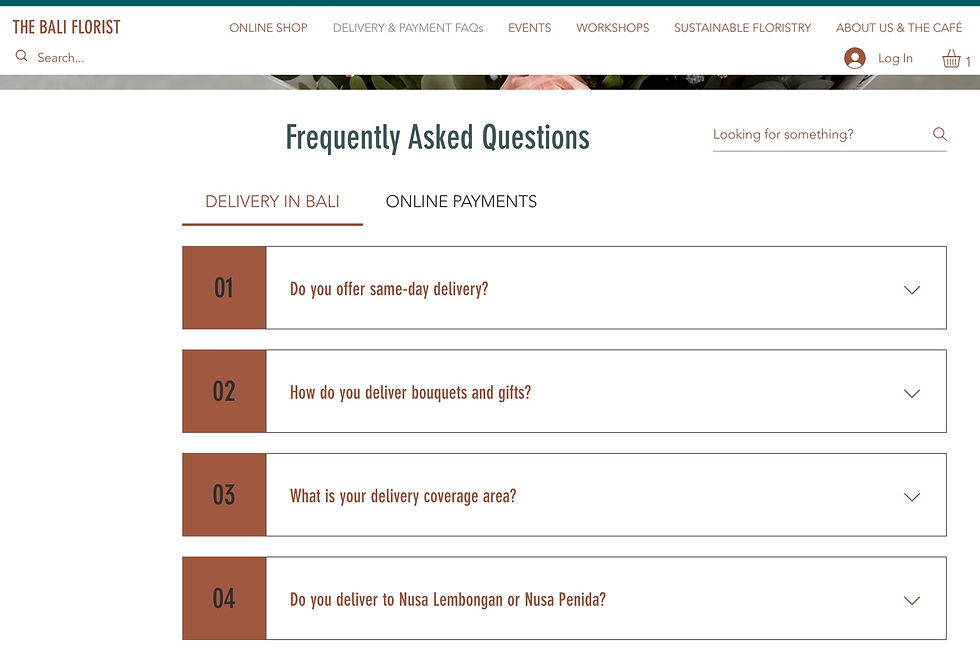
For a florist, that might mean clearly explaining delivery areas, product types, ordering procedures, wedding services, opening hours, substitutions, pricing or how same-day delivery works. The interesting difference is that people are no longer necessarily searching with two or three keywords.

Someone might now ask: “Can you recommend a florist in Bali that accepts international payment and can deliver flowers to a hotel in Sanur tomorrow?” That is a much more conversational request. And a florist whose website clearly explains those things has given search engines and AI-powered search tools far more useful information to work with than one whose online presence consists mainly of photographs and captions.
This makes maintaining a website — and actually keeping its content updated — increasingly relevant. A website should no longer be treated as something that was built five years ago and then forgotten.
Think of it a little like a book in a library or bookstore. A perfectly good book can sit quietly on a shelf for years, but without being revisited, recommended, updated or brought back into view, fewer people may discover it. A website is much the same: it needs attention, fresh information and relevant content to remain useful and visible.
Why Many Independent Florists Still Hesitate
Of course, it is easy to say every florist should have a good website. Building and maintaining one is another matter entirely.
Independent florists are usually florists first. Their working day revolves around sourcing flowers, conditioning them, designing arrangements, dealing with deliveries, answering customers and occasionally wondering how quite so many buckets need washing.
Website architecture is not necessarily high on that list.

Technology can therefore feel intimidating. Domains, hosting, payment gateways, search optimisation, image sizes, product pages and website updates can quickly sound like an entirely separate profession.
For a small independent florist, paying an outside company to build and continuously maintain a sophisticated website may also simply be too expensive. That helps explain why many very good florists still have either a very basic website — or no website at all.
The Network Alternative
Another route has traditionally been to join larger online florist networks or flower-delivery platforms. These networks can be valuable. They provide access to customers a florist may never have reached independently and can generate additional orders through an established sales channel.
But there are compromises. When many florists are competing within the same marketplace, products inevitably become easier to compare primarily by price. Standardised product categories and price expectations can also leave less room for an individual florist's particular design style, sourcing standards or way of working.

For some businesses, that model makes perfect sense. For others, particularly small florists trying to build a distinct identity and maintain certain quality standards, complete dependence on a third-party marketplace may not.
Owning your own website gives you something those platforms cannot completely provide: your own space. You decide how your flowers are presented, how much information a customer receives, what products you sell, what areas you deliver to, what your policies are and, importantly, what you don't want to sell.
A Website Can Also Filter for the Right Customer
There is another benefit to having your own website that is perhaps less obvious: it acts as a kind of soft filtering system. Not every customer is looking for the same thing, and not every florist needs to serve every type of customer.
People who take the time to browse our website, look through the products, read the descriptions and understand how we work are generally the customers we are best suited to serve. They have a clearer idea of what they are ordering and, importantly, they understand the value behind the product rather than simply looking for the fastest or cheapest option available. That matters to us.
The Bali Florist is not built around competing for the lowest possible price or taking every last-minute order that appears in a message inbox. We prefer to focus on customers who appreciate the product, the design, the service and the way we work. In that sense, the website does some of the filtering for us.
There will always be customers who prefer to order through WhatsApp, and that is perfectly fine. But messaging is not necessarily the most efficient way to process an order — either for the customer or for the florist. A simple order can quickly turn into a long exchange involving product choices, colours, pricing, delivery areas, recipient details, card messages, payment confirmations and delivery times. And after all that back-and-forth, the conversation may still not result in an order.
The more information that is passed manually from one message to another, the more opportunity there is for something to be misunderstood, missed or entered incorrectly.
A website reduces much of that friction.
The customer can see the product, enter the correct recipient information themselves, choose the relevant options, review the order and complete payment in one place.
For the florist, that means fewer repetitive messages, less manual data entry and a lower margin for error.
So while WhatsApp remains a useful communication tool, we see the website as the better ordering system. It is not only more efficient; it creates a clearer and more deliberate customer journey from browsing to purchase.
The Website as the Shopfront
For us, social media and websites therefore serve different purposes rather than competing with one another.
Instagram can introduce someone to The Bali Florist. Google — and increasingly AI-powered search — can help them discover us when they are actively looking for something specific. Our website then gives them the information and confidence they need to place the order.
And ultimately, that is what our website has become: our shopfront. Except this particular shopfront never closes, can be visited from almost anywhere in the world and doesn't require another member of staff standing behind the counter.

For a small florist, that is quite powerful. The technology itself is not particularly romantic. Nobody became a florist because they dreamed of payment gateways, search indexing or updating product descriptions. But perhaps that is also the point.
A florist's website is not really about becoming more technological. It is about becoming less dependent on everybody else's platform. The website is not just another sales channel; it protects the independence of a small florist. It allows you to decide what you sell, how you price it, what your policies are, how customers experience your business and how your brand is presented — without handing all of that control over to social-media platforms or larger florist networks.
And for a small creative business, that independence may be one of the most valuable things technology can offer.
Where Flowers Meet the Future
Perhaps that is the more interesting question for florists looking ahead: if our love for flowers is what brought us into this work, what new skills might help us carry that passion further?
Could learning a little more about websites, search, photography, writing, design or even AI become another creative part of the job rather than something to fear?

Floristry has always required us to keep learning — new flowers, new techniques, new styles, new ways of seeing. Perhaps technology is simply another material to play with. So what might happen if, instead of seeing technology as something outside our craft, we became curious enough to make it part of it?


Comments